
|
Ancient ice sheet mysteryAugust 25, 2007Courtesy of Far North Science 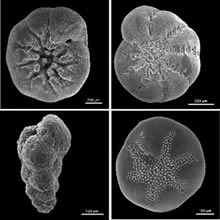
Benthic foraminifera Over millions of years, the sheets grew to cover vast landscapes, then subsided and melted back,possibly in response to periodic changes in the Earth's orbit, possibly triggered by rise and fall of greenhouse gases like CO2. One recent interpretation argued that extensive ice covered both hemispheres about 41 million years ago - despite other evidence that an ancient greenhouse impact had baked the Earth to much higher temperatures than we see today. Well, the North was ice free after all, according to a new study by core-drilling scientists with the Joint Oceanographic Institutions, drawing on samples taken during expeditions in the early 2000s. A team of scientists taking cores from the Atlantic Ocean's Demerara Rise to find clues into ancient climate reported this week in Nature that an analysis of certain tiny fossils prove that ice sheets didn't exist in the Far North at that time. In the article No extreme bipolar glaciation during the main Eocene calcite compensation shift, the authors argue that there was enough space on Antarctica to accommodate all the world's ice. Here's more detail from the Joint Oceanographic Institutions: New research to test global ice volume approximately 41.6 million years ago shows that ice caps at this time, if they existed at all, would have been small and easily accommodated on Antarctica. The findings contradict a recent controversial suggestion that Earth was extensively glaciated at this time despite having been much warmer than today, most likely because of high atmospheric carbon dioxide levels. 
Richard Norris In an article published in Nature on 23 August, researchers using pinhead-sized fossils (foraminifera) - collected from sediments deep beneath the Atlantic Ocean, 380 km north of Suriname, South America - say large continental ice sheets did not exist in both hemispheres around 41 million years ago.This result is more in keeping with other geological records and climate model results suggesting that the threshold for ice sheet inception would have been crossed earlier in the Southern Hemisphere than in the Northern Hemisphere because the South Pole has a continent sitting over it (Antarctica) whereas the North Pole has an ocean (the Arctic). "The beauty of the new results is that they resolve a big problem," explained Paul Wilson, lead proponent of ODP Expedition 207. "How can there have been more ice than today during an interval that was much warmer than today? The answer is that there was not more ice - that idea was a mistake based on inadequate data. The results give us renewed confidence in our understanding of the sequence of geological events and thus the controls on ice sheet existence." Wilson is on the faculty of the School of Ocean & Earth Science at the UK's National Oceanography Centre, Southampton. "The research is a classic example of the amazing way in which the Earth System is so intricately integrated," said co-proponent Dick Norris of University of California, San Diego, Scripps Institution of Oceanography. "Isn't it a marvelous thing that we can learn so much about the polar continental ice caps by examining tiny fossils that lived on the sea floor at the equator."  Most of Far North Science is written and edited by Doug O'Harra, a writer and journalist based in Anchorage, Alaska.
 |
|