
|
|
|
March 31, 2008
NOAA Studies Pollutants in Ice-Free Region of Arctic
A field study now under way is looking at the pollutants within the Arctic atmosphere - called "Arctic Haze" - including their sources, concentrations, and climate impact, in an ice-free region. 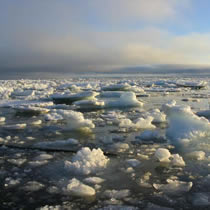
"The study will focus in particular on short-lived pollutants that may be contributing to the accelerated warming in the Arctic relative to the global average warming," said Patricia Quinn, a research chemist at NOAA's Pacific Marine Environmental Laboratory in Seattle and co-chief scientist of the study. The International Chemistry Experiment in the Arctic Lower Troposphere, or ICEALOT, is one of NOAA's contributions to the International Polar Year. ICEALOT is part of the larger, multi-agency international Polar Study using Aircraft, Remote Sensing, Surface Measurements and Models, of Climate, Chemistry, Aerosols, and Transport, or POLARCAT. Before traveling to the Arctic, the scientific team sailing aboard the Woods Hole Oceanographic Institute R/V Knorr, spent some time along the U.S. Atlantic coast, collecting samples for the multi-year New England Air Quality Study, which looks at air pollution sources and transport in that area. The ICEALOT working area will take the ship into the Norwegian, Barents, and Greenland seas, stopping in Tromso, Norway, before ending in Reykjavik, Iceland on April 28. "These measurements also will provide a baseline before further decreases in ice coverage result in increases in ship traffic and associated pollution along the Northern Sea Route and Northwest Passage," said Tim Bates, a research chemist at PMEL, and co-chief scientist. Arctic summer ice has been melting faster than scientists had projected. A reduction in ice could open new transportation routes in that area. The team also includes scientists from NOAA's Earth System Research Laboratory in Boulder, Colo. © AlaskaReport.com All Rights Reserved.
|
|