
|
|
|
Crab Rationalization Review Is No SurpriseFishery Transition Team Identified Lack of Strategic Vision:By Stephen Taufen - On December 18, 2006, the Fish & Game Transition Team released its Issues Report to Alaska's newly elected Governor Sarah Palin. It included efforts by a Commercial Fish Subcommittee that outlined five top priorities and ten other concerns. 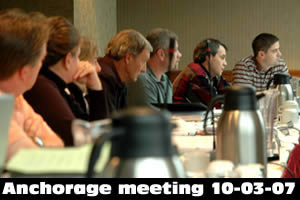
The transition team identified as its top priority that "the State lacks both a cohesive vision for Alaska's seafood industry and fishery dependent communities, and a strategy to achieve that vision." The consequences of inaction would be "lost economic opportunity for the seafood community, lost State revenue, and negative social-economic consequences for many communities and businesses." It recognized that, "Alaska's fisheries are a 'sustainable permanent fund' and produce a significant amount of economic activity for the state ($2 billion first wholesale value; #1 private sector employer, and #1 fishing port in U.S.). Yet we are not achieving the full potential of the resource, nor are we achieving the constitutionally mandated maximum benefit for the people." Furthermore, "Neither the seafood industry (due to lack of cohesion/competition) nor the state government has a clear vision for the internal coordinating mechanisms to make Alaska the seafood industry powerhouse that is potentially there." And, "Without a viable seafood industry several communities will collapse and generate social costs as evidenced by recent fishery downturns." The commercial fishery transition team recommended that Alaska use transparent and public processes to develop a clear strategic vision and institutionalize an ongoing strategic planning and evaluation process, and implementation plan. It recommended the State develop an organizational structure - such as a seafood cabinet. Governor Palin's restructuring - moving away from having an absurd 'fish czar' chair in the governor's office - started with implementing a multi-agency new fisheries sub-cabinet that consists of a fishery liaison, along with the commissioners from several key departments: fish and game, natural resources; revenue; commerce, community and economic development; transportation and public facilities; etc. Crab Rationalization Review Needed: The commercial fishery transition team members also identified a review of the federally implemented Crab Rationalization regime as a top-five concern. They stated that the consequences of inaction would be that "the program would continue in its present form, and the problems that exist will continue and in all likelihood get worse." There has been much written about the key concerns about layoffs of crab crewmembers & lower pay for those deckhands remaining in the fishery; how skippers got 3% of the quota in "C shares" but the deckhands and engineers got nothing; that many fishery dependent communities that now have collapsed economies; and especially about the increased consolidation of the crab industry (and the entire North Pacific seafood industry, in general). The recent merger of two of Japan's largest fishing companies - #1 Maruha (owner of Western Alaska Fisheries and others) and #3 Nichiro (owner of Peter Pan Seafoods) - caused the combined corporate interests to exceed the maximum allowed processor cap of 30% of the TAC/quota. We have a phone call or two in to state and federal offices, and hope to update readers at a later date on the antitrust investigation level. Moving on... Crabber Almost Left Without a Market: As a result, several fishermen were advised that they might lose their crab markets, like independent crabber Lu Dochtermann of Kodiak (see last Groundswell article on AlaskaReport) who fished 21 seasons for Peter Pan Seafoods. By the time the Council had begun its October 2007 review of crab, Peter Pan Seafoods had capitulated and offered season markets to Dochtermann, for both his 2007 king crab and 2008 opilio crab. Nevertheless, we still pointed out in public comments that Lu had received his "best last offer" - and it consisted of "get out of King Cove before the next Rising Sun!" One would think that 21 years of delivery loyalty, including two within the new crab ratz regime, constitutes some form of contract. And the capitulation was welcome, as Dochtermann's vessel, the Stormbird, was readying to leave port within days for the king crab fishery, and needed to match-up IFQs with PQs and know where it was to deliver crab. It was easy to suspect that Peter Pan Seafood did not want Dochtermann to file a federal fisheries lawsuit, but that the Cooperatives of crab vessel owners tied to particular processors through the share match programs also did not want the legal issues placed before a federal judge. Lu had viewed participation in a cooperative as joining a de facto horizontal price-fix conspiracy, and aligning with a conspiracy to defraud crewmembers from receiving their verifiable historical participation as vessel operators, too. In testimony to the NPFMC on Lu's behalf, I pointed out that recent reports had additionally outlined the lack of value-added products (opportunities not being developed), contrary to promises that crab rationalization would provide a business environment where higher net benefits might occur. And while many on the Council seemed comfortable with 'compressed time frames' for share match-ups, on Lu's behalf we stated that this was wholly unacceptable to actual vessel operators who have to ready for the season, make plans for parts and crew, etc. The problem of "finding your partner" (share match-up) was recently taken to its most absurd level by the RAM division of NOAA Fisheries Alaska having to rework its quota allocations up to three more times, in just one week. The Paperwork Reduction Act apparently doesn't apply when you "ram through quotas." Another issue was that of Immunity for the arbitrators - vulture lawyers - as if they are akin to judges, who should be free to participate in negotiations without recourse. The problem is, using lobbyists-as-arbitrators in price negotiations is not the same as a courtroom where a balance of adversarial positions is attained under strict rules. And judges, unlike arbitrators, don't have paying clients - many of whom are or have been the very crab processors subject to negotiations. At this point, I have to head out the door for another KUDO 1080 Anchorage, Talk Radio show - a Friday "fish fry" of sorts, put on by former fishery crewmember Shannyn Moore. We've been doing about one show weekly for the past month, and folks such as recent gubernatorial candidate Eric Croft (former state legislator), and senator Bill Wielechowski (a current member of the resource committee) have joined in with Shannyn to discuss similar concerns about the real value of Alaska's seafood. Hopefully, they will help communicate to the public and Legislature why a Resource Accountability and Transparency Board is needed to properly review the real value of Alaska seafood, not the falsified book values that result from the cross-border accounting trickery of "abusive transfer pricing" strategies (international tax evasion). Please look at the attached PDF on the Council's motion regarding Crab Rationalization, that came out of the October meeting. Please treat it as a draft copy, as the series of motions and amended motions left many unclear on certain details, such as wording addressing crew. But one thing is for certain. The processors and their lawyers and lobbyists were having a tough time getting used to the idea of a new governor, and a State that may finally stand up for the constitutional rights to maximize seafood industry revenues for the benefit of all. Stephen Taufen - Groundswell Fisheries Movement Contact Stephen TaufenA public watchdog and advocate for fishermen and their coastal communities. Taufen is an "insider" who blew the whistle on the international profit laundering between global affiliates of North Pacific seafood companies, who use illicit accounting to deny the USA the proper taxes on seafood trade. The same practices are used to lower ex-vessel prices to the fleets, and to bleed monies from our regional economy. |
>
|