
|
|
|
February 10, 2009
Why don't hibernating bears get osteoporosis?By Ned RozellBears have the right idea. Don't fight the cold; just shut 'er down for six months and emerge when it's warmer. Why didn't we think of that? 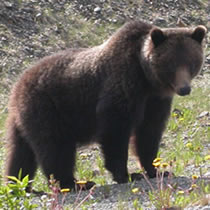 Despite putting almost no load on its bones for more than half the
year, this grizzly bear doesn¹t have osteoporosis. Photo by Ned Rozell.
Despite putting almost no load on its bones for more than half the
year, this grizzly bear doesn¹t have osteoporosis. Photo by Ned Rozell.For one thing, our bones would wither. We'd all get osteoporosis, a disease in which bones become more fragile. Bears don't get osteoporosis, even though they hibernate for more than half the year in Alaska. What might we learn from this? Seth Donahue of Michigan Tech University is trying to find out. He was in Fairbanks recently, giving a seminar sponsored by the University of Alaska Fairbanks' Institute of Arctic Biology on using bears as a model for preventing osteoporosis. He started off his lecture by showing an x-ray of a female tennis player's forearms. The bones within her right forearm were larger than those in her left. "If you overload bone, you have bone gain," he said. "There's more bone formation in the racquet arm of a tennis player." The opposite happens when people are inactive; bones get thinner, and bones develop little holes in them that make them brittle. Even when people get back on their feet, bones don't recover so well, rarely regaining the strength they had before. That's why hibernating black and grizzly bears perform what seems like a miracle. They don't lose bone mass during a half-year of inactivity, despite not eating, not moving much, not urinating or defecating, and, for mother bears, giving birth and nursing cubs. Donahue and his colleagues have studied hibernating bears and have found that bears don't lose bone mass during hibernation. They somehow even seem to build stronger bones. "Bears are becoming less (prone to osteoporosis) during hibernation," Donahue said. "Their bone mineral content is maintained during hibernation." Not only that, unlike our bones, a bear's bones get stronger and less porous as it gets older. Donahue has discovered these facts by studying bears from Michigan, Virginia, Washington, and Utah, and by testing the strength of bear bones donated by hunters near his lab in Houghton, Michigan. He wants to tease out what makes bears different from humans. Ten million Americans suffer from osteoporosis, often treated with drugs known as bisphosphonates. "Bisphosphonates slow it down, but we need bone-building drugs," Donahue said. In the search for bears' secrets that could lead to a development of a new drug, Donahue has checked out the animals' parathyroid hormones, which seemed to be the key to their impressive bone resilience. He and his lab colleagues treated rats that had suffered bone loss with synthetic bear parathyroid hormone as well as the same hormone from humans. Both reversed the rats' bone loss, a result that disappointed the researchers but also taught them something. They learned that "it's not bear (parathyroid hormone) on its own doing the trick," Donahue said. The bears' hypothalamus, an almond-size part of the brain that controls a number of metabolic and nervous system processes, might also be a part of the magic within bear bones. Donahue and his colleagues have modified the synthetic bear hormone and have partnered with a drug company in an attempt to get something on the market. "We're optimistic that our new version of black bear parathyroid hormone will eventually lead to a new osteoporosis drug for humans," Donahue said. This column is provided as a public service by the Geophysical Institute, University of Alaska Fairbanks, in cooperation with the UAF research community. Ned Rozell is a science writer at the institute. © AlaskaReport.com All Rights Reserved. |
|