
|
|
|
September 16, 2008 Arctic Ocean ice shrinks to second lowest on recordCourtesy of Far North Science The countdown to the annual Arctic slush cup has ended, and the realm of polar bear and ice seal has shrunk yet again. The meltback may not be as bad as last year, but it's worse than any other season logged by the satellite record. 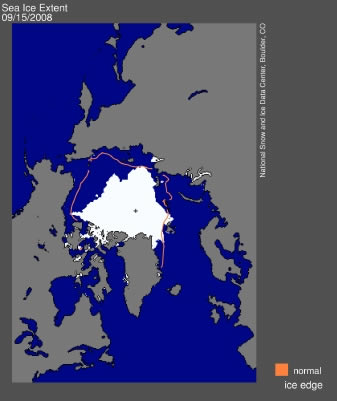
How bad was it? The Arctic Ocean ice cap has basically lost an area three times larger than Texas. The eye-in-the-sky scientists from the National Snow and Ice Data Center said today that the extent of Arctic sea ice hit its minimum coverage over the weekend and has begun to slowly refreeze for the winter. The floes and pans that create the floating bedrock of the polar ocean's ecosystem - providing the necessary hunting platforms for polar bears and the undersea nurseries for plankton and fish - covered only about 1.74 million square miles on Sept. 12. That coverage is still about 150,000 square miles bigger than the all-time record minimum set last fall, the NSIDC pointed out in a release (complete with links and graphics.) But given the Arctic's remarkably cool 2008 summer, a season where ice melt ought to have slowed dramatically, it's not good news. While above the record minimum set on September 16, 2007, this year further reinforces the strong negative trend in summertime ice extent observed over the past thirty years. . The 2008 minimum is the second-lowest recorded since 1979, and is 2.24 million square kilometers (0.86 million square miles) below the 1979 to 2000 average minimum. Let's put the loss in perspective. The NSIDC says: The 2008 minimum extent is 15.0 % less than the next-lowest minimum extent set in 2005 and 33.1 % less than the average minimum extent from 1979 to 2000. .. This season further reinforces the long-term downward trend of sea ice extent. OK, the 33.1 % reduction from the average minimum extent amounts to about 860,000 square miles. But that's such a large figure that it's difficult to visualize. So let's do a quick-and-dirty thought exercise. Imagine the contiguous United States as the average summer Arctic ice cap. What happened this year? California, Arizona, New Mexico, Texas and Oklahoma all melted away. Here's more overview from NSIDC: The spatial pattern of the 2008 minimum extent was different than that of 2007. This year did not have the substantial ice loss in the central Arctic, north of the Chukchi and East Siberian Seas. However, 2008 showed greater loss in the Beaufort, Laptev, and Greenland Seas. Unlike last year, this year saw the opening of the Northern Sea Route, the passage through the Arctic Ocean along the coast of Siberia. However, while the shallow Amundsen's Northwest Passage opened in both years, the deeper Parry's Channel of the Northwest Passage did not quite open in 2008. Sea ice typically shrinks in extent and volume during the late summer months, eaten by sun-warmed ocean water and flushed into the Atlantic by currents. But what used to be a slight peeling back of the thick, royal-blue, steel-hard continent of ice off Alaska's north coast has transformed into a disappearing act. The result? The coastal residents of Arctic Alaska regularly enter the stormy fall with a vast fetch of ocean at their backs. Here's more to consider: The frozen surface of the Arctic Ocean serves as the hunting platform and resting place for thousands of marine mammals like polar bears, walrus and seals. With so much of the basic summer habitat destroyed, setting the stage for a much reduced winter ice cover, polar bears and other ice-dependent animals will almost certainly find it much harder to find enough to eat. As a result, the US Fish and Wildlife Service proposed that polar bears be listed as threatened in the United States, due to the inexorable loss of their summer hunting habitat. (More polar bear links here.) Nine polar bears were spotted swimming miles from land or ice this summer in the open seas north of Alaska, according to this news from the World Wildlife Fund. These latest developments come one year after the 2007 season, when Arctic ice disappeared faster than climate models said was possible. At the time, a NOAA study compared models with observations and concluded the ice free Arctic could be about 30 years off. Other federal scientists reported that most polar bears - including all Alaska populations - would be gone by mid-century. The retreat of the polar ice cap also poses heartbreaking problems for the people of Alaska villages like Shishmaref and Kivalina. With a fetch of open water stretching 1,000 miles or more, storms can build exceptionally big surf that consumes the barrier islands beneath village homes, tank farms, schools and roads. Lack of thick multi-year ice makes hunting less predictable and more dangerous. Most of Far North Science is written and edited by Doug O'Harra, a writer and journalist based in Anchorage, Alaska. © AlaskaReport.com All Rights Reserved. |
|