|
Humpback whale visits Alaska 35 years laterMay 14, 2007Courtesy of Far North Science A humpback whale first seen 35 years ago in Southeast Alaska was photographed swimming off Maui in February 2006 and in Seymour Canal in December 2006 - becoming the longest scientifically tracked humpback on record. 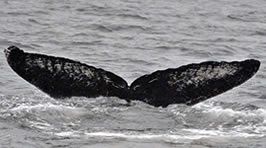 Dan Salden of the Hawaii Whale Research Foundation took this photograph of whale NMMLID 229 in Southeast Alaska's Seymour Canal on December 3, 2006. Dan Salden of the Hawaii Whale Research Foundation took this photograph of whale NMMLID 229 in Southeast Alaska's Seymour Canal on December 3, 2006.The whale, thought to be a male designated NMMLID 229, was identified by comparing photographs of the markings and shape of its flukes. Using images of distinctive features to keep track of long-lived, ocean-crossing marine mammals like humpbacks and killer whales (scientists photograph the left side of orca dorsal fins and saddle patches) has evolved into one of the most important tools in a cetacean scientist's box.
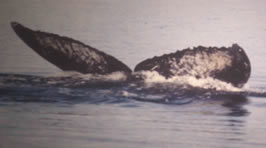
Charles Jurasz photographed the flukes of humpback NMMLID 229 in Frederick Sound on August 15, 1978 This particular whale was first sighted in 1972 in Lynn Canal near Juneau by pioneering whale researcher Charles Jurasz. Its flukes went into a federal database, allowing scientists to pinpoint the animal off and on over decades. "With last year's sightings, this whale has the longest identification record, 35 years, of any humpback whale", said NOAA's Alaska Fisheries Science Center Director Doug DeMaster said in a NOAA news release. "The record is a tribute to Charles Jurasz' pioneering work, which started in the mid-1960s, long before whale biologists considered using photo-identification as a research tool." "In the years since Charles Jurasz and a few other early pioneers started using photographs to identify individual whales, it's become commonly accepted for researchers to use photographs for individual whale identification," DeMaster added. NMMLID 229 has been photographed more than 34 times over the years in Alaska and Hawaii by researchers from the Alaska Fisheries Science Center, the University of Hawaii, The Dolphin Institute, the Hawaii Whale Research Foundation, the Center for Whale Studies, the Center for Coastal Studies and others. The latest IDs came off Maui by researchers from The Dolphin Institute and again by researchers working with Sitka whale researcher Jan Straley in Southeast Alaska's Seymour Canal. NMMLID 229 isn't the only whale first identified by Charles Jurasz that has shown up decades later in Alaska, although NMMLID 229 still holds the lead. At least nine other Jurasz whales were seen in Glacier Bay National Park and Preserve last summer, according to whale biologist Chris Gabriele. The whole prospect has got federal biologists thinking that there might be other old whale photos out there that might be matched to whales in the database. DeMaster wants people to consider sharing these early photos with date and place.
More details: The Alaska Fisheries Science Center humpback whale database has over 30,000 photographs taken from throughout the North Pacific, sent in by researchers working in Japan, Mexico and the US west coast as well as Alaska and Hawaii.  Most of Far North Science is written and edited by Doug O'Harra, a writer and journalist based in Anchorage, Alaska.
 |
|